
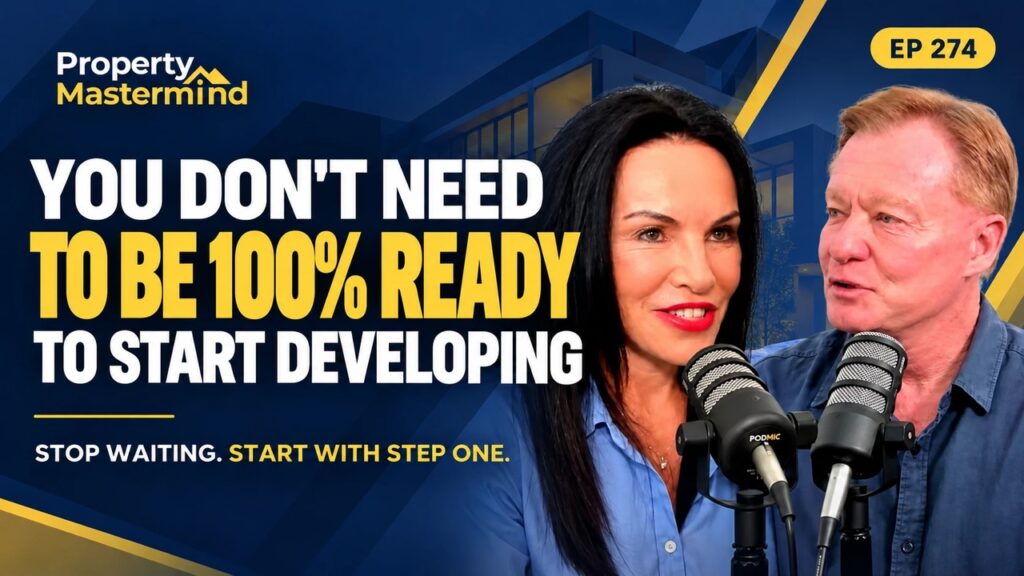
Ask people why they have not started in property development and the answers are remarkably similar. Not enough money yet. Not enough knowledge yet. The market is not right. No site. Not confident enough. On a recent episode of the Property Mastermind Podcast, Bob Andersen and Hilary Saxton worked through each of those reasons and reached the same conclusion every time: you do not need to be ready to start. Here is what you do need.
Almost nobody starts ready
Bob did not. When he began he had some money but not enough, and could have spent years saving the rest. He had little knowledge, at a time when there were no courses and nobody to learn from. He did not understand how the market worked. In his words, he was ready and willing, not necessarily able.
What he had instead was a strong reason and a simple plan. A car accident had left him laid up for the best part of a year, and he decided his life was going to change. With no way to study development, he took a job in real estate, and chose the agency deliberately because it sold land subdivisions on behalf of developers. That put him in regular contact with the people doing what he wanted to do, and it led to his first project.
There is no perfect property market
“I’ll wait until the market settles” is one of the most common reasons to delay. Bob’s response is that the market is dynamic. It is never perfectly good and never perfectly bad. Interest rates, inflation, land availability, population growth and supply all move, and they react to one another. The combination of low unemployment, low inflation, low rates, high demand and short supply all at once will probably never arrive.
Two practical points follow. First, a development usually takes 18 months to two years from buying the site to completion, so you are not selling into today’s market in any case. Second, when sale prices soften slightly, sites tend to get cheaper at the front end too. And developers do not operate in “the Australian market”. One suburb rises while the next falls, which is why the advice is to choose an area and get to know it deeply.
You only need the first three steps now
You do not have to understand the entire development process in detail before you begin. Get a quick overview of all of it, then concentrate on the early steps:
- What can I afford to do?
- Where should I do it?
- What sort of product should I develop?
You need to know that choosing a builder, getting a building permit and marketing the finished product are coming. You do not need to know how to do them yet.
The trap of learning forever
Bob tells of a man who approached him after a talk in Sydney and listed every property course he had ever taken. He had spent a very large amount on education over many years. Asked what he was actually doing, he said nothing, and then gave a long list of reasons why he could not. That is analysis paralysis. Education is critical, and you cannot simply wing it, but the point of learning is to act. Learn it, then start.
Build your team before you find a site
If you wait until you have a site to look for professionals, you are late. Start with an accountant and a lawyer. Add a building designer or architect and a surveyor. Speak to a town planner early, because a planner will tell you what zoning and lot size to look for. Talk to local agents, and to builders who are working for other developers in your area. As Bob puts it, you cannot know too many people.
Confidence comes after action, not before
What separates people who develop from people who only want to is action, and that does not mean rushing in. Confidence is not a prerequisite. It is built incrementally. Every agent you meet, every open home you inspect, every conversation toward your goal adds a little. Mentoring students often ask, “What do I actually say?” They have the conversation once and discover they can do it. Action creates traction, and traction creates momentum.
The other half is protecting that momentum. A small hold-up, a structure not yet set up, a tax return you are waiting on, is often enough to stall everything. When that happens, go back to your reason for starting.
Six things you do not need
- You do not need to quit your job.
- You do not need to know everything.
- You do not need to be a builder.
- You do not need to have found a site.
- You do not need a million dollars.
- You do not need to feel completely confident.
If you are waiting on several of those, it is worth asking whether the reasons are really valid.
Hear the full conversation, including why so many people stop after their first project: listen to episode 274 of the Property Mastermind Podcast. And if you want the whole process laid out from step one, the free Profit with Property Development Masterclass is on Saturday 21 November 2026, 9am to 1pm AEDT, live on Zoom with Bob and Hilary.