
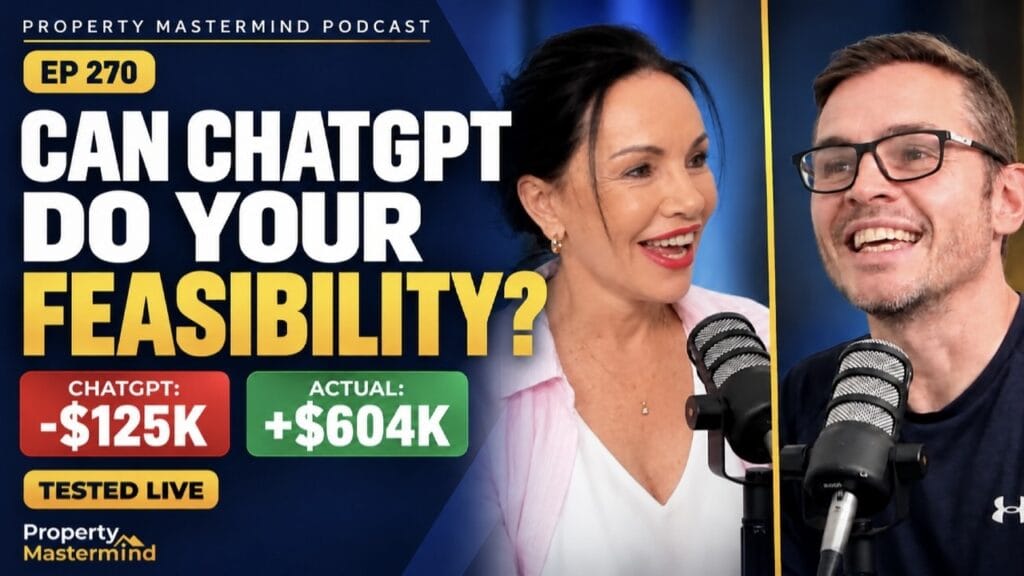
Can artificial intelligence do a property development feasibility you can rely on? It is one of the most common questions new developers ask, and the honest answer is more interesting than a yes or no. On a recent episode of the Property Mastermind Podcast, Hilary Saxton and Aaron Ralph ran a live test to find out. They gave the newest ChatGPT model a real duplex site the team had already developed and sold, asked it whether the deal stacked up, and compared its answer with what actually happened. Here is what they found, and what it means for anyone using AI in property.
The experiment: a site with known numbers
Aaron chose 146 Oceanic Drive at Warana on the Sunshine Coast, a duplex pair that Property Mastermind developed as a joint venture with students. The land was bought in 2023 and the finished product sold in early 2025, so every number in the feasibility has been ticked off in real life.
He set ChatGPT to one of its highest levels of thinking, told it to look at the site as if it were deciding whether the deal stacked up, asked it to run the numbers as at 2023, and told it not to cheat by reading the real feasibility sitting on his computer. Then he let it run.
What the AI came back with
It was impressive to watch. The model found the land price through public records, worked out the site was 591 square metres, dug into the planning controls, built spreadsheets, pulled comparable sales and researched for the best part of half an hour. Then it reported, with total confidence, that the project would lose about $125,000 before tax.
The real result was a $604,000 profit at 15.84 percent return on cost. As Aaron put it on the episode, not even in the ballpark. If you had relied on those numbers you would never have found a deal in any market.
Round two: giving it the three biggest numbers
To give the AI a helping hand, Aaron then handed it the three biggest numbers in any feasibility, which together make up around 80 percent of it: the land at $1.605 million, construction at $1,689,774 and a gross realisation value of $4.7 million. With that head start, it came back with an 11 percent return on cost.
Better, but still a deal that goes in the bin. For a duplex, an 11 percent return would not get finance, and a deal you cannot fund is not a deal. When Aaron looked closer, the AI had also included equity in its numbers. Property Mastermind runs its feasibilities on 100 percent debt using what they call the valuer’s methodology. Done that way, the AI’s answer would have been even further out.
Why a general model gets it wrong
ChatGPT is a general model. It has been fed an enormous amount of information, and unless you are hyper specific and tailor everything to your situation, it pushes toward the median. It does not know that a development site has to be assessed the way a lender’s valuer assesses it. And in development, the numbers do not need to be far out to turn a deal into a non-deal.
The dangerous part is the confidence. The answer arrives with spreadsheets, research and comparables, typed up in front of you, and it is very easy to believe. A conservative mistake costs you deals you should have done. A rosy mistake is worse. You spend money on approvals, get to construction finance, and the lender says no.
The valuer’s methodology, in plain English
The biggest risk a developer faces is getting commercial finance. So when you assess a site, the name of the game is to look at it the way the lender will. The person who tells the lender what a development site is worth is the valuer, and valuers use a very specific method. If your feasibility puts in equity, produces less interest and makes the deal look better than the valuer’s version will, you are kidding yourself, and you will find out at the worst possible time. And when developers say “the bank”, they usually mean a non-bank lender. It is commercial finance, not the residential loan you got for your house.
Where AI is genuinely brilliant for developers
None of this means stay away from AI. Aaron’s working day is unrecognisable from six months ago. His role has moved from hands-on to orchestrating a team of AI agents that run around the clock, and he runs his own models on his own hardware doing nothing but feasibilities and looking for sites, with other models checking their work. The difference is that he taught them how a feasibility is actually put together. The knowledge went in first.
For everyday use, AI is fantastic for the tedious tasks that eat your attention and create decision fatigue. It is superb for research questions about populations, towns and markets. And it is a genuine relief for reading planning schemes and codes, which can otherwise do your head in.
The takeaway
Use AI. Download it, talk to it, and give it the hardest thing you can think of. But for the big decisions, the specialist knowledge still has to come from you. Development is one of the few careers that rewards a jack of all trades, and the numbers are the one thing a developer can never hand off. Pair real knowledge with AI and, in Aaron’s words, it is real estate development on steroids.
Want to watch the whole test, including Aaron’s screen and the prompts he used? Watch episode 270 of the Property Mastermind Podcast. And if you want to learn property development properly, with a full segment on using AI in your business, join Bob, Hilary and Aaron at the Property Development and Joint Ventures Workshop on the Gold Coast, 9 to 11 October 2026.